Not long ago, digital visibility meant one thing: rank on Google’s first page. Build backlinks, target keywords, earn clicks.
That model still works but it no longer tells the whole story.
Today, a growing share of searches never produce a list of blue links at all. Google’s AI Overviews answer questions before a user scrolls. ChatGPT and Perplexity synthesise responses without sending traffic anywhere. Voice assistants read one answer aloud and stop.Not long ago, digital visibility meant one thing: rank on Google’s first page. Build backlinks, target keywords, earn clicks. Simple.
That model still works but it no longer tells the whole story.
Today, a growing share of searches never produce a list of blue links at all. Google’s AI Overviews answer questions before a user scrolls. ChatGPT and Perplexity synthesise responses without sending traffic anywhere. Voice assistants read one answer aloud and stop.
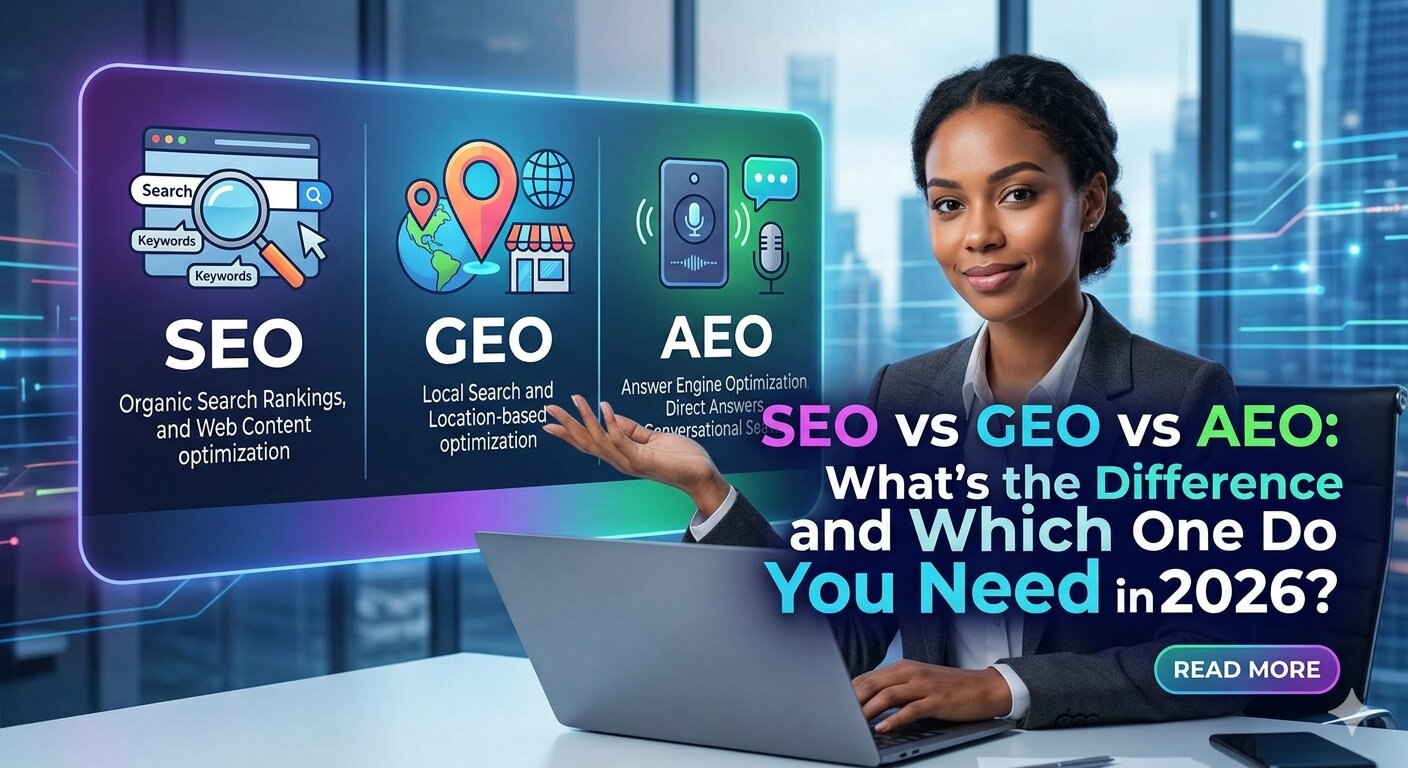
Three distinct strategies have emerged to address this fractured landscape: SEO, AEO, and GEO. Each targets a different type of engine, measures success differently, and requires a different approach to content.
This guide breaks down exactly what each one means, how they differ, and most importantly which combination your business needs right now.
- SEO (Search Engine Optimization) helps your pages rank high on Google and Bing so users click through to your site.
- AEO (Answer Engine Optimization) structures your content to be selected as the direct answer in featured snippets, AI Overviews, and voice search.
- GEO (Generative Engine Optimization) builds your brand’s authority so AI tools like ChatGPT, Gemini, and Perplexity cite you when generating answers.
None of these replaces the others. SEO is the foundation. AEO builds on it. GEO extends it further. All three matter in 2026.
What Is SEO (Search Engine Optimization)?
SEO is the practice of improving your website so it ranks higher on traditional search engines like Google and Bing. When someone types a query, the search engine crawls billions of pages and decides which ones best answer that query. SEO is how you signal to that engine that your page deserves a top spot.
It works across three core areas:
- Technical SEO : making sure search engines can crawl and index your site without issues. Think site speed, mobile-friendliness, clean URL structures.
- On-page SEO : optimizing the content itself. Title tags, headings, keywords, internal links, and content quality all live here.
- Off-page SEO : building authority through backlinks and brand mentions from other credible websites.
The goal of SEO is a click. You show up in the results, the user sees your page, and they choose to visit it.
SEO has been the foundation of digital marketing for over two decades and in 2026, it still is. The difference is that it no longer operates alone.
What Is AEO (Answer Engine Optimization)?
AEO is the practice of structuring your content so it gets selected as a direct answer not just ranked as a result. Instead of earning a click from a list of links, the goal is to be the answer that appears before the user even has to choose.
This matters because search behaviour has shifted. People ask full questions “What is the difference between SEO and AEO?” and expect an instant, precise response. Google’s AI Overviews, featured snippets, People Also Ask boxes, and voice assistants like Siri and Alexa all pull from content that is structured to answer clearly and concisely.
If your content cannot be summarized cleanly into a direct response, answer engines will skip it entirely.
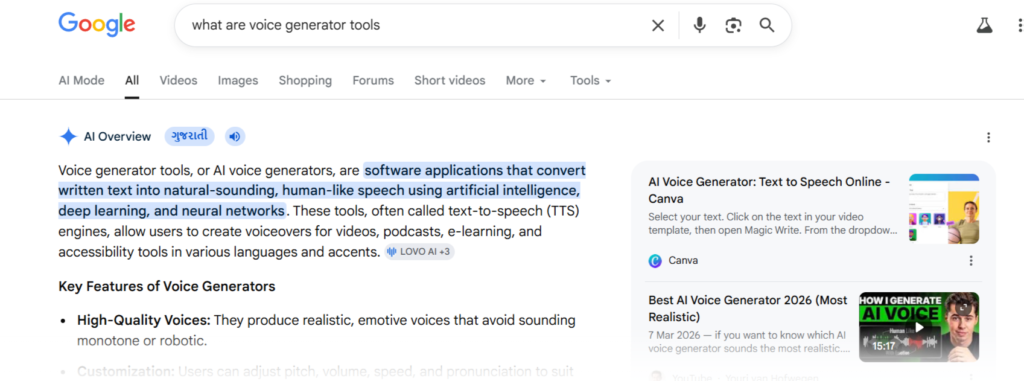
Common AEO strategies include:
- FAQ schema markup : tagging your Q&A content so search engines can identify and extract it easily.
- Structured Q&A formatting : writing in a question then-answer pattern with direct, concise responses under each heading.
- Featured snippet optimization: leading paragraphs that define a term or answer a question in 40–60 words.
- How To and Article schema: structured data that tells search engines exactly what type of content you have published.
- Conversational keyword targeting : optimizing for natural language queries rather than short keyword phrases.
AEO does not replace SEO. It builds directly on top of it a well-indexed, technically sound page is still the prerequisite for any answer engine to trust your content.
What Is GEO (Generative Engine Optimization)?
GEO is the practice of making your brand and content recognizable as a trusted source to generative AI platforms. Unlike traditional search engines that return a list of links, tools like ChatGPT, Google Gemini, Perplexity, Claude, and Microsoft Copilot read across the web, synthesise information, and generate a single composed answer often without showing the user any links at all.
GEO is about making sure that when these AI systems generate an answer in your category, your brand is part of that answer.
This is a fundamentally different challenge from SEO or AEO. Generative AI does not rank pages, it decides which sources it trusts enough to draw from. That trust is built over time through consistent authority signals, content depth, and brand presence across multiple platforms.
Common GEO strategies include:
- Building topical authority : publishing comprehensive, interconnected content that covers your niche in depth, not just individual keywords.
- Entity consistency : making sure your brand name, description, and expertise are presented consistently across your website, social profiles, directories, and third-party mentions.
- Earning citations and mentions : getting referenced by credible external sources, industry publications, and forums that AI systems are known to draw from.
- Original data and insights : publishing research, statistics, or unique frameworks that other content naturally references, making you a primary source worth quoting.
- Multi-platform content distribution : maintaining a visible presence on platforms like LinkedIn, Reddit, and YouTube, where generative AI engines frequently pull information from.
- Clear, unambiguous language : writing in a way that AI can accurately paraphrase and attribute. Dense jargon or vague claims are harder for AI to extract and cite confidently.
One important distinction: GEO does not always drive direct traffic. When ChatGPT mentions your brand in a response, the user may not click anywhere. But the brand visibility and trust that builds over time influences decisions long before a search ever happens.
SEO vs AEO vs GEO: Key Differences at a Glance
While SEO focuses on ranking in Google’s blue links, AEO helps your content appear directly as the chosen answer in AI-powered search features, and GEO ensures your brand is cited and trusted by generative AI systems across platforms like ChatGPT and Gemini.
Together, they represent the new reality of modern search visibility where success is no longer just about being clicked, but about being seen, selected, and cited at every stage of how people find information today.
The three strategies are not competing priorities. They are complementary layers that solve different visibility problems. Here is how they break down side by side:
| Dimension | SEO | GEO | AEO |
|---|---|---|---|
| Full name | Search Engine Optimization | Generative Engine Optimization | Answer Engine Optimization |
| Primary goal | Rank high on Google/Bing SERPs | Be cited/referenced by generative AI | Be the direct answer shown to users |
| Target engine | Google, Bing, Yahoo | ChatGPT, Gemini, Perplexity, Claude | Featured snippets, voice search, AI Overviews |
| Traffic type | Click-through traffic | Brand visibility; rarely direct clicks | Zero-click visibility + some traffic |
| Key signals | Backlinks, technical health, E-E-A-T | Entity authority, topical depth, citations | Schema markup, Q&A structure, concise answers |
| Measurement | Rankings, organic traffic, CTR | AI share of voice, brand citation count | AI overview wins, voice impressions |
| Time to results | 3–6 months typically | Ongoing; builds over 3–12 months | 4–8 weeks with correct signals |
How to Implement SEO, AEO, and GEO: Practical Tactics
Understanding the differences between SEO, AEO, and GEO is one thing knowing what to actually do is another. Below are the practical tactics for each strategy that work in 2026, organized so you can act on them immediately regardless of where you are starting from.
SEO Tactics in 2026
SEO remains the non-negotiable foundation. Without it, neither AEO nor GEO can function properly. A page that cannot be crawled, indexed, or trusted will never be selected as an answer or cited by an AI system.
- Fix your technical foundation first. Ensure your site loads fast, is mobile-friendly, has clean URL structures, and has no crawl errors blocking key pages. These are table-stakes in 2026.
- Build topical clusters, not isolated pages. Instead of publishing random blog posts, organise your content into pillar pages and supporting articles around a core topic. This signals depth of expertise to Google.
- Prioritise E-E-A-T signals. Add author bios with real credentials, cite credible sources, display clear publication and update dates, and keep your content factually accurate. Google’s ranking systems reward demonstrable expertise.
- Earn quality backlinks, not just volume. A handful of links from genuinely relevant, authoritative sites outperforms dozens of low-quality directory links. Focus on digital PR, original research, and guest content on industry publications.
- Optimise for Core Web Vitals. Page experience signals loading speed, visual stability, and interactivity directly influence rankings. Run regular audits using Google Search Console and PageSpeed Insights.
- Update existing content regularly. Refreshing older articles with current data, updated examples, and new internal links can recover lost rankings faster than publishing new content from scratch.
AEO Tactics in 2026
AEO is about making your content easy for answer engines to extract and present. The simpler and more direct your content structure, the higher the chance it gets pulled into a featured snippet, AI Overview, or voice search result.
- Lead every section with a direct answer. Before expanding into detail, open each major section with a clear 40–60 word response to the implied question. This is the format featured snippets and AI Overviews prefer.
- Implement FAQ schema markup. Add JSON-LD FAQ schema to any page with a question-and-answer section. This explicitly signals to Google that your content contains structured answers worth surfacing.
- Write in a question-then-answer format. Use H2 or H3 headings phrased as actual questions the kind your audience types or speaks. Follow each with a concise, standalone answer that makes sense without surrounding context.
- Target People Also Ask (PAA) queries. Research PAA boxes for your primary keywords and build dedicated sections or FAQ entries that directly answer those questions. Each PAA win increases your overall answer engine footprint.
- Use HowTo and Article schema where relevant. For instructional content, HowTo schema helps search engines understand the step-by-step structure of your page, making it easier to surface in relevant answer contexts.
- Keep answers self-contained. Each answer should make complete sense on its own. Avoid responses like “as mentioned above” or “see the previous section” answer engines extract individual blocks, not full pages.
GEO Tactics in 2026
GEO is the longest game of the three. It is less about individual page optimisation and more about building the kind of brand authority that AI systems consistently recognize and reference over time.
Keep your content factually precise and clearly attributed. Vague claims, unsourced statistics, and ambiguous language are difficult for AI to cite confidently. Write with specificity named sources, concrete numbers, clear conclusions so AI systems can accurately represent your content without risk of misattribution.
Establish clear entity signals. Make sure your brand name, what you do, and who you serve are stated explicitly and consistently across your website, Google Business Profile, LinkedIn, and any other platform where you have a presence. AI systems build their understanding of your brand from these signals collectively.
Publish original data, research, or frameworks. Generative AI tools gravitate toward primary sources. An original survey, a proprietary methodology, or a unique named framework gives other content something to reference and gives AI systems a reason to cite you specifically.
Get mentioned on platforms AI systems trust. Reddit threads, industry forums, reputable news sites, Quora answers, and established blogs are all sources generative AI draws from heavily. Genuine participation and contribution on these platforms builds your citation footprint organically.
Go deep on fewer topics rather than broad on many. AI systems recognise topical authority. A brand that has published 20 deeply researched articles on one topic will be cited far more reliably than a brand with 100 shallow posts spread across 10 unrelated topics.
Monitor your AI visibility regularly. Use tools like Otterly.ai, Brandwatch, or simple manual prompt testing across ChatGPT, Gemini, and Perplexity to see how your brand currently appears or does not appear in AI-generated answers. You cannot improve what you are not measuring.
FAQs
What is the difference between SEO, AEO, and GEO?
SEO helps your website rank in traditional search engines like Google so users click through to your pages. AEO structures your content to be selected as the direct answer in featured snippets, AI Overviews, and voice search results. GEO builds your brand’s authority so generative AI tools like ChatGPT and Gemini reference you when composing answers. All three solve different visibility problems and work best when used together.
Is GEO replacing SEO?
No. GEO extends SEO it does not replace it. Strong domain authority, clean technical health, and quality backlinks are still prerequisites for any AI system to trust and cite your content. Think of SEO as the foundation that makes GEO possible in the first place. Brands that abandon SEO in favour of GEO alone will find their AI visibility eroding over time as their core authority weakens.
What is AEO and how does it differ from traditional SEO?
Traditional SEO optimizes for rankings you want your page to appear high in a list of results. AEO optimizes for selection you want your content to be the single answer displayed above those results, or read aloud by a voice assistant. SEO gets you on the menu. AEO makes you the recommended dish. The two rely on the same technical foundation but require different content structure and formatting approaches.
How do I optimise my content for AI tools like ChatGPT or Gemini?
This falls under GEO. Start by building consistent entity signals make sure your brand, expertise, and topic focus are clearly defined across your website and external platforms. Publish original insights and data that other sources reference. Earn mentions on platforms AI systems draw from, such as Reddit, industry publications, and established blogs. And write with precision specific claims, named sources, and clear conclusions are far easier for AI systems to cite accurately than vague or generic content.
Should I focus on SEO or GEO in 2026?
It depends on where you are today. If you are starting from scratch, build SEO and AEO in parallel SEO takes time to compound, while AEO can generate visibility in as little as four to eight weeks with the right structure. If you already have strong SEO but notice traffic dropping despite maintained rankings, your gap is likely AEO. If your SEO and AEO are solid but your brand does not appear when people ask AI tools about your category, that is when GEO becomes the priority.
What is the difference between GEO and AEO?
AEO focuses specifically on getting your content selected as a direct answer within search engine interfaces featured snippets, AI Overviews, and voice results. GEO is broader it focuses on being recognised and cited by standalone generative AI platforms like ChatGPT, Perplexity, and Gemini that operate outside the traditional search engine context. In simple terms, AEO targets AI features within search. GEO targets AI systems that have replaced search entirely for a growing number of users.
What does AEO stand for in digital marketing?
AEO stands for Answer Engine Optimization. It refers to the practice of structuring content so it gets extracted and presented as a direct answer by search engines and AI-powered search features, rather than simply appearing as a ranked link that users have to click. It is particularly relevant for voice search, featured snippets, and Google’s AI Overviews.